
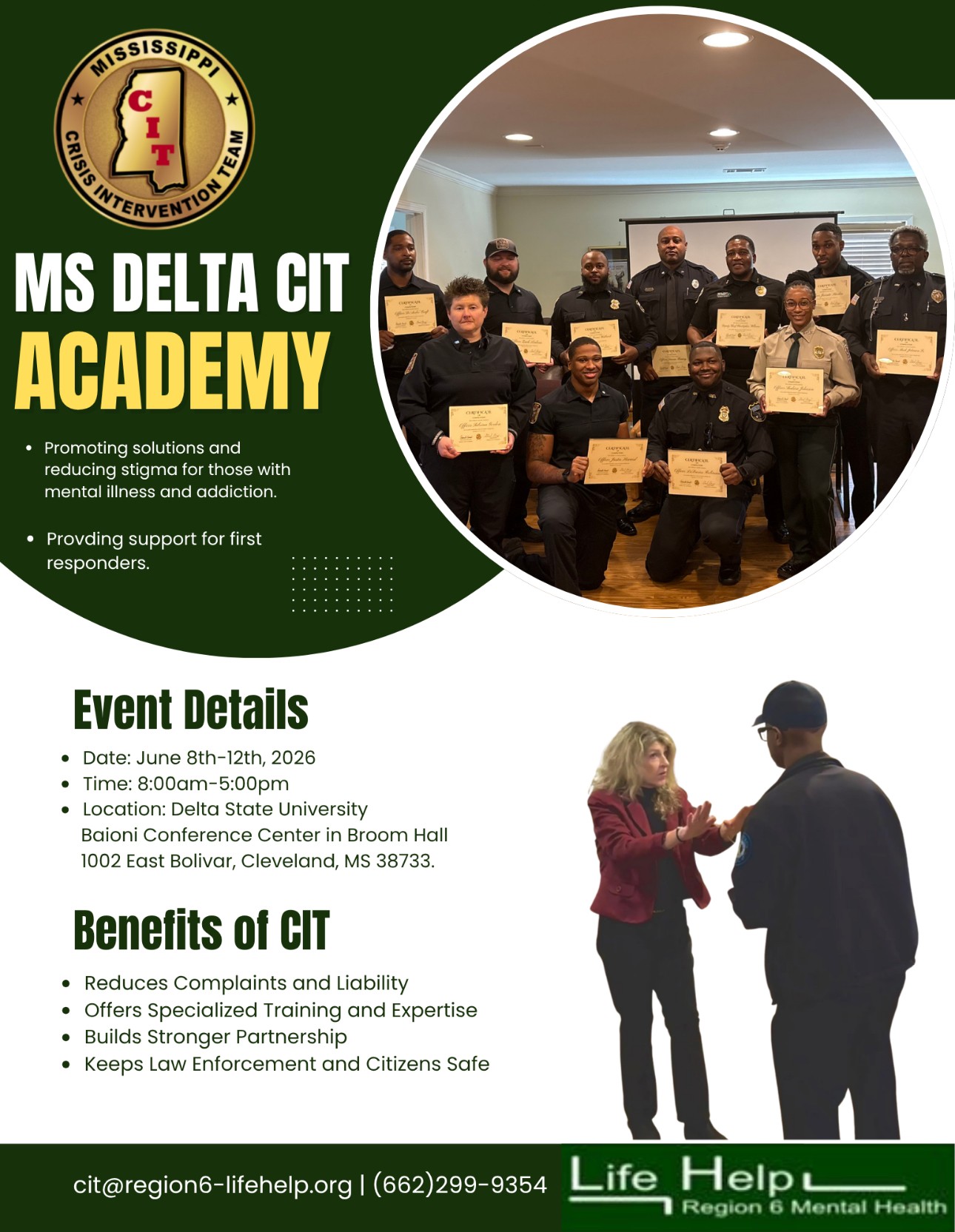
 Flyer for MS Delta CIT Academy event
CLEVELAND, Miss. — Delta State University and the Delta State Police Department will host two upcoming professional training opportunities aimed at strengthening public safety, enhancing investigative capabilities and improving outcomes for communities across the Mississippi Delta.
The Mississippi Delta Crisis Intervention Team (CIT) Academy will be held June 8–12, from 8:00 a.m. to 5:00 p.m. daily at the Baioni Conference Center in Broom Hall on the Delta State campus. The academy is designed to equip first responders with the tools and strategies needed to effectively assist individuals experiencing mental health and addiction-related crises.
Focused on promoting solutions and reducing stigma, the CIT Academy provides specialized, scenario-based training that supports law enforcement, emergency personnel, and community partners. Participants will learn techniques to safely de-escalate situations, connect individuals with appropriate care and build stronger collaboration between public safety agencies and mental health providers.
Benefits of the CIT Academy include reducing complaints and liability, offering specialized training and expertise, building stronger partnerships between agencies and communities and helping keep both law enforcement personnel and citizens safe. Additional information about the program and its regional impact is available on their website at region6-lifehelp.org or by calling 662-299-9354.
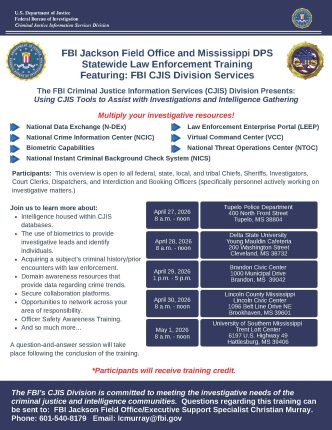 In addition to the CIT Academy, Delta State Police will also serve as a host site for a statewide law enforcement training led by the FBI Jackson Field Office in partnership with the Mississippi Department of Public Safety. The training, titled “Using CJIS Tools to Assist with Investigations and Intelligence Gathering,” will take place on April 28, from 8:00 a.m. to noon at the Young-Maudlin Cafeteria on campus.
Presented by the FBI’s Criminal Justice Information Services (CJIS) Division, the session will provide an in-depth overview of powerful investigative tools and databases used by law enforcement agencies nationwide. Topics will include the National Data Exchange (N-DEx), National Crime Information Center (NCIC), Law Enforcement Enterprise Portal (LEEP), Virtual Command Center (VCC), biometric identification capabilities, the National Threat Operations Center (NTOC) and the National Instant Criminal Background Check System (NICS).
The training is open to federal, state, local and tribal law enforcement professionals, including chiefs, sheriffs, investigators, court clerks, dispatchers and booking officers actively engaged in investigative work. Attendees will gain insight into intelligence resources housed within CJIS systems, learn how to leverage biometric data for identification, access criminal history information and utilize secure collaboration platforms to enhance interagency coordination.
Participants will also benefit from networking opportunities, officer safety awareness training, and a question-and-answer session following the program. Training credit will be awarded to those who attend. For more information, visit the CJIS Division’s website at fbi.gov/services/cjis.
“Hosting both the CIT Academy and the FBI CJIS training here at Delta State reflects our commitment to giving law enforcement the tools they need to serve more effectively,” said DSU Police Chief Michael Peeler. “These programs not only strengthen investigative capabilities and officer safety but also reinforce the importance of understanding and responding appropriately to mental health crises. When we invest in this kind of training, we’re building stronger partnerships and safer communities across the Delta.”
By hosting these two programs, Delta State University and the Delta State Police continue to support the professional development of first responders and law enforcement personnel while reinforcing its commitment to community engagement and public safety across the region.